Portrait artists like Christan Nicholson, Cyril Leeper and Trevor Goring capture the unique personalities of the legal profession in their art. Archives and heritage collections keep this history alive.

Across Canada, thousands of paintings line the walls of private firms, the halls of Parliament and the Senate, law schools and art galleries. They show faces of strength, dignity, distinction, and some with just a hint of roguishness or amusement. Lawyers fresh from the courtroom. Chief Justices looking at the viewer, faces lined by an awareness of their responsibility in carrying the weight and history of the law on their shoulders. Prime ministers, who honed their sharp debating skills in the courtroom, striking a pose. All of them confirm the legal world’s essential place in Canadian history.
Eleven prime ministers (of a total of 24), three governors-general and dozens of premiers were lawyers before serving the country and provinces. So, it’s not surprising that, when you see a portrait of a Canadian politician from the 19th or 20th century, the odds are you will see a lawyer.
Canada’s House of Commons and Senate
A multitude of paintings are displayed in Ottawa. The House of Commons includes 5,000 items in its heritage collection. The Senate holds 6,000 works, including portraits of former Senate Speakers.
Perhaps the most sought-after artwork for Parliament visitors is the prime ministerial portrait gallery, located in the House of Commons Foyer. Many portraits feature elements of the Legislature, like its Gothic architecture. They all demonstrate a range of artist interpretations. Among the artwork:
The 1889 portrait of John A. Macdonald, Canada’s first prime minister, who looks vice-regal in crimson sash against gold brocade. Artist Henry Sandham captures Macdonald’s confident, proud face and posture.
The 1991 portrait of Pierre Trudeau by Myfanwy Spencer Pavelic shows the former prime minister reclining slightly, open coat hanging over his shoulders with artful insouciance, trademark red rose peeking out from under a lapel. His gaze is at once bright, piercing and resolute.
The 2004 portrait of Kim Campbell by David Goatley. Canada’s first female prime minister is seen in a thoughtful pose, leaning slightly on a chair draped with a legal gown; a scarlet Musqueam cape from B.C. and crimson doctoral robes hang on the wall behind her.
The 2010 oil portrait of Jean Chrétien by Christan Nicholson, renowned as a no-nonsense, plain-spoken lawyer and politician from Shawinigan Falls. Chrétien wears a dark suit and red tie, set against a brilliant yellow background. Chretien’s face is one of toughness and resolve. He looks all too ready to deliver his infamous “Shawinigan Handshake.” At its unveiling, William Huffman, associate director of the Toronto Arts Council, quoted in the National Post, called the piece “bold and eye-catching” with Chrétien taking a stance that “implies action.”
Canada’s top-ranked artists include Christan Nicholson, Cyril Leeper and Trevor Goring.
Christan Nicholson
A graduate of Mount Allison University with a BFA (with Distinction), Christan Nicholson’s career has taken him across the country. His portraits include lawyer, business magnate and politician Izzy Asper and famed Toronto lawyer Richard Winter, KC, along with a host of university chancellors and industry leaders. He said in a YouTube video that his ability to put people at ease and his “gift of the gab” helped him with his portrait subjects.
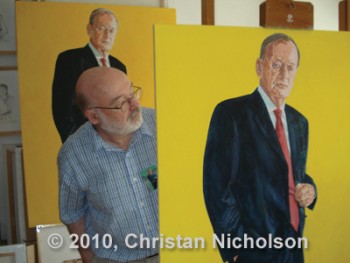
In a telephone interview, Nicholson says art curators “were telling me, ‘You capture personality’ and they would say ‘Your work reminds me of [famed photographer Yousuf] Karsh.”
Nicholson’s portrait of former prime minister Chrétien continues to attract significant attention. Chrétien’s daughter, France Chrétien Desmarais, a fan of Nicholson’s work, asked him to work on the portrait. Nicholson spent time with Chrétien in Shawinigan, taking photographs and getting to know him.
“He’s a lovely human being, he’s very easy to talk to,” says Nicholson of Chrétien. Nicholson spent 18 months working on several versions of the portrait. The one with the bright canary backdrop was the final choice for the House of Commons portrait gallery.
Cyril Leeper
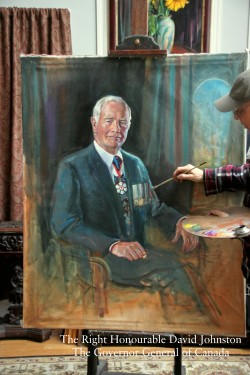
A distinguished Canadian portrait painter, Cyril Leeper’s subjects include governors-general, members of the British royal family and Supreme Court Chief Justices Richard Wagner and Beverley McLachlan, and Federal Court Chief Justices Julius Isaac and John Richard.
Toronto-born Leeper studied under members of the Group of Seven at what is now the Ontario College of Art and Design, as well as at Italy’s Accademia di Belle Arti di Roma and in Spain. In Canada, he studied under premier portrait artist Kenneth Forbes. He received the Queen Elizabeth “Gold Jubilee Medal” in 2002 and the Saskatchewan Medal in 2005.
Leeper says over the phone that he focuses on the “expression in the eyes” when painting. The eyes contain the subject’s essence, and he works on head shape, facial features and hands, leaving the eyes to the end. He tells an anecdote of painting the portrait of former governor-general David Johnston. At its unveiling, Johnston’s wife told the crowd, “‘I want to point something out here. This artist has captured the mood, the expression … he has captured my husband so much,’ and then she started to weep.” That was key to the success of Johnston’s portrait, Leeper says, and underscored his early training that focused on three essentials: conception, composition and style.
Trevor Goring
Trevor Goring was born in London, UK, and trained at Saint Martin’s College of Art. He has spent a lifetime in the arts, exhibiting his art in museums and galleries, publishing magazines, and teaching at the Montreal Museum School of Fine Arts. He is founding director of the Trial Lawyer National Portrait Gallery and the creator of the Images of Justice fine art collection, which its website describes as “the world’s only art gallery for attorneys.”
He spent decades painting portraits of judges, historical legal figures and trial lawyers. His contact list reads like a Who’s Who of the famous: defence lawyers Brian and Eddie Greenspan, the Supreme Court’s Morris Fish, Frank Iacobucci and John Sopinka, and U.S. Associate Justice of the Supreme Court Sonia Sotomayor.
In his art, Montreal-based Goring celebrates the legal profession’s history and values. According to his website, he “lectures extensively on ‘visual advocacy’ and creative confidence, providing visual communication consulting to help attorneys present complex cases in court.” Legal news correspondent Rene Perras reported in 2025 that “Goring [is] creating what may be the most comprehensive visual record of trial lawyer history ever assembled.”
In a phone interview, Goring says he became interested in painting members of the legal community after seeing them mocked in artwork: “they show sharks approaching the judge’s bench… or taking the wallet out of the back pocket of their client.” Goring knew they deserved respect. Originally not a portrait painter, he has spent three decades creating a vibrant graphic narrative of the lawyer’s world.
While Goring rarely feels nervous about painting a famous subject, he says “there’s always a little edge to taking on a new client and managing their expectations… I always try and get people to show me photographs of themselves that they like, so that I have a sense of how they see themselves. That’s an important thing to do.”
Gathering places for history: Law Society of Ontario and Legal Archives Society of Alberta
According to Elise Brunet, curator, Law Society of Ontario (LSO), “our collection decorates the walls, documents people, events and our evolution, honours the sitters, and represents continuity and stability, for the Law Society of course, but also for Ontario’s judicial system and for visitors to Osgoode Hall.” In 1846, members of the legal profession donated the LSO’s first portrait of John Beverley Robinson, Attorney General of Upper Canada and later Chief Justice.
Today, the LSO receives a new painting every few years, and space is at a premium. Looking after the work is also challenging, as some works are very old or large, and “several are hung in stairwells or very high on walls,” says Brunet via email. “Access and transportation are complicated. Conservators often don’t have studios large enough to handle such large works.”
Some faces in LSO’s portrait gallery are well-known, others less so.
“From a historical point of view, people like John Beverley Robinson, William Warren Baldwin, Robert Baldwin and Edward Blake are recognized not only for their contributions to the legal profession and the justice system of Ontario, but for their impact on Canadian history,” says Brunet. “J.J. Robinette and R. Roy McMurtry are known by many, even outside of the legal professions, but there are many others, several whose names grace the signs of modern law firms. Laura Legge is often singled out because she was both the Law Society’s first female elected bencher and its first female treasurer.”
While some were donated, “by the late 19th century, the Law Society had taken over the commissions and purchased or commissioned portraits of earlier chief justices to complete its collection,” says Brunet.
Calgary-based Legal Archives Society of Alberta (LASA) is the official archival repository for the Law Society of Alberta. LASA Archivist Brenda McCafferty says that while artwork makes up less than 3% of LASA’s holdings, all items receive gentle care. LASA stores artwork in temperature- and humidity-controlled vaults, “often encased in Mylar, and inside oversized acid free file folders,” McCafferty says via email. Among LASA’s holdings are “an art print of Alexander S. Williamson, Q.C. (1913-1983) by artist R. Syme” and portraits by the artist Dorothy Oxborough of Secretary W.B. Kelly, Chief Justice of the Court of Queen’s Bench W.K. Moore, and Chief Justice of Alberta William A. McGillivray.
Conveying emotion
To see a portrait is to experience the essence of a subject’s personality. The artwork is meant to convey a sense of emotion and storytelling to the viewer.
According to Goring, “portraits can be very emotional, and I’ve had a number of portraits used when people have passed away and put on display at the funeral, which is always a great tribute in a way. What I want people to do is interpret the narrative, to feel that passion for justice that the character has dedicated their life to.”
To bring out the subject’s hidden spirit, the artist must break the ice and get them to reveal something of themselves, says Leeper. “Everybody has this sort of mask that they use for their profession… they hold a certain look and demeanor, and any idiosyncrasies that are real are hidden.” Bringing out the true essence of a subject demands that subject and artist find some common ground, and then “you start to get to know the person.”
Portraits are important for the subject and creating that portrait is just as compelling for the painter. Christan Nicholson says painting someone’s portrait can allow for a sense of intimacy, friendliness and the creation of a “genuine rapport, and that is a wonderful thing.”
Looking for more information?
Looking for articles like this one to be delivered right to your inbox? SUBSCRIBE NOW!
DISCLAIMER The information in this article was correct at time of publishing. The law may have changed since then. The views expressed in this article are those of the author and do not necessarily reflect the views of LawNow or the Centre for Public Legal Education Alberta.
 About John Cooper