All resources are free and available for download on cplea.ca. We hope that this will raise awareness of the many resources that CPLEA produces to further our commitment to public legal education in Alberta. For a listing of all CPLEA resources go to: www.cplea.ca/publications In this … [Read more...]
Alternatives to Court: Mediation

In the first column in this series, John-Paul Boyd introduced basic alternatives to resolving family law disputes in court. In the second column, I wrote about the Collaborative process. In the last issue, John-Paul Boyd explained arbitration. In this column, I’m going to talk about … [Read more...]
State Neutrality Does Not Always Result in Substantive Equality

Recently, Quebec Premier François Legault’s government introduced Bill 21 (An Act Respecting the Laicity [Secularism] of the State). Among other things, the Act prohibits public workers in positions of authority (e.g., teachers, police officers, prison guards, Crown prosecutors, government lawyers … [Read more...]
Alberta Election Legislation and Charities

After years of turmoil around the topic, the federal government moved recently to reform treatment of charities’ “public policy dialogue and development activities”. The reform was, at least in part, in response to the striking down as unconstitutional of certain provisions of the Income Tax Act … [Read more...]
To Stop or not To Stop? Police Carding Practices

In R. v. Omar, 2018 ONCA 975 (CanLII), the Ontario Court of Appeal has rubber stamped the illegality of what is commonly referred to as carding, declaring that “[Everyone has] every right to be walking down the street unimpeded by the police” (at para 51). In a stunning decision where the Crown’s … [Read more...]
Accommodation in Tenancy: Assistance and Support Animals

Sometimes tenants require the assistance and support of an animal. Are landlords required to accommodate a tenant with an assistance or support animal? Well, part of the answer depends on the type of animal involved: does the situation involve a disabled tenant with a qualified service or guide dog, … [Read more...]
Political Belief and Discrimination in Employment Law

The Canadian Human Rights Act sets out prohibited grounds of discrimination under s. 3(1): For all purposes of this Act, the prohibited grounds of discrimination are race, national or ethnic origin, colour, religion, age, sex, sexual orientation, gender identity or expression, marital status, … [Read more...]
The Duty of Unions to Fairly Represent Their Members

Unions are accountable to workers by the doctrine of "duty of fair representation", the parameters of which are set out in case law. Plight of the unionized worker The average unionized worker is in a weak position at work. In many workplaces he will, as a condition of employment, be required to … [Read more...]
Building the New Jerusalem, One Clause at a Time

The Saskatchewan Bill of Rights, 1947, was landmark legislation that inaugurated a new era in Canadian law. The Bill, which contained a clear description of the rights and freedoms to be protected by the provincial government, anticipated the much better known document of the United Nations, which … [Read more...]
Moving Toward a New and Improved Senate
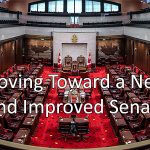
The following is the summary of a study completed by Paul G. Thomas on the Senate of Canada. The Senate of Canada has changed significantly as a result of the 2014 decision by Justin Trudeau, then leader of the Liberal party, to remove Liberal senators from the parliamentary caucus; and by his … [Read more...]